
The best leg workouts target the quads, hamstrings, glutes, and calves in a single session — using compound movements like squats and deadlifts as the foundation, then finishing with isolation work or bodyweight exercises to add volume. You don't need a commercial gym to train legs effectively. A barbell, some dumbbells, and a handful of well-chosen exercises cover the majority of what serious leg development requires.
This guide covers 10 of the most effective leg exercises you can do at home, with muscles worked, form cues, sets & reps, and a complete leg workout plan for every training level.
1. Front Squat
Muscles worked: Quads (primary), upper back, core (secondary)
Most people skip the front squat because it's uncomfortable to learn. That's a mistake. Putting the bar on your front delts instead of your upper back changes everything — your torso stays more upright, your knees track further forward, and your quads end up doing far more work than they ever do in a back squat. If quad size is what you're after, this one earns its spot.

To set up, walk up to a barbell at shoulder height and take an overhand grip just outside your shoulders. Drive your elbows up until your upper arms are parallel to the floor — the bar sits on your front delts, not balanced in your palms. Unrack it, step back, feet shoulder-width with toes slightly out. Breathe in, brace hard, and sit straight down as deep as your mobility allows. Stand back up by pushing the floor away, elbows staying high the whole way.
The thing that kills most front squats is the elbows dropping on the way down. The moment they fall, the bar shoots forward and you're fighting to stay upright instead of actually squatting. Keep them up — even when the weight gets heavy and your wrists start complaining.
Sets & reps: 3–4 sets of 5–8 for strength, 3 sets of 8–12 if you're chasing size.
2. Romanian Deadlift
Muscles worked: Hamstrings, glutes (primary), lower back (secondary)
If your hamstrings are a weak point — and for most people they are — the Romanian deadlift fixes that faster than anything else. You start standing, push your hips back, and lower the bar down your legs until you feel a genuine stretch in the back of your thighs. That stretch is the whole point. This isn't about how much weight you can move; it's about how well you can load a muscle that most people never actually train through its full range.

Push your hips back, bar staying close to your legs the whole way down. You'll feel the hamstrings load up somewhere around mid-shin — that's your stopping point, not the floor. Hips drive forward to bring you back up, glutes contracting at lockout.
Rounding the lower back to squeeze out extra depth is the mistake that follows people for years with this lift. Two more inches of range isn't doing anything useful if your spine is taking the hit. Find where your back stays neutral and treat that as your bottom position.
Sets & reps: 3–4 sets of 6–10 reps.
3. Bulgarian Split Squat
Muscles worked: Quads, glutes (primary), hamstrings, core (secondary)
The Bulgarian split squat is one of those exercises people avoid because it's genuinely hard, not because it doesn't work. Training one leg at a time means neither side can cheat — if your left quad is weaker than your right, you'll know within the first set. The elevated rear foot also puts you through a range of motion that regular lunges don't come close to, which is why your glutes and quads tend to be sore in completely new places the first few times you run these.
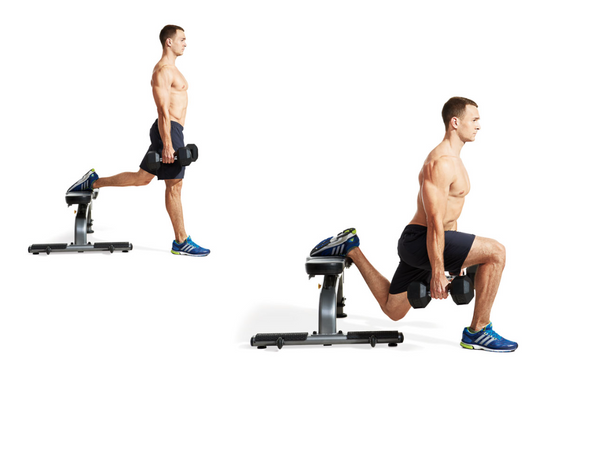
Set up a lunge-length from a weight bench, dumbbell in each hand, back foot resting on top. Drop straight down until the front thigh hits parallel and the back knee clears the floor by an inch or two. Chest stays tall. Push through the front heel to get back up.
Front foot too close to the bench is what gets most people. The knee ends up way out over the toes, the joint takes more stress than it should, and the whole movement feels wrong. Slide your front foot forward until the shin is nearly vertical at the bottom — that's the position you want.
Sets & reps: 3 sets of 8–12 per leg.
4. Barbell Squat
Muscles worked: Quads, glutes (primary), hamstrings, lower back, core (secondary)
Spend enough time around serious lifters and you'll notice something — the ones who squat heavy consistently just carry more muscle on their legs than people who don't. That's not a coincidence. Nothing else loads the quads, glutes, hamstrings, and posterior chain all at once the way a loaded barbell on your back does.

Set the bar just below shoulder height. Get under it, let it sit on your upper traps — not your neck — and pinch your shoulder blades together to give it something to rest on. Walk it out, feet shoulder-width, toes angled out slightly. Breathe into your belly, brace your whole midsection, and sit back and down until your hip crease drops to knee height or just below. Then push the floor away.
The two things that wreck this lift are adding weight too fast and letting the knees cave on the way up. Nine times out of ten they trace back to the same problem — the glutes aren't keeping up with the load. If the knees are drifting in, strip some weight and rebuild from there.
Sets & reps: 4 sets of 6–8 for strength, 3 sets of 8–12 for size.
5. Single-leg Romanian Deadlift
Muscles worked: Hamstrings, glutes (primary), core, lower back (secondary)
Try this for the first time and you'll probably discover your left and right sides are nowhere near as balanced as you thought. That's partly the point. One leg working alone means the stronger side has nowhere to hide, and whatever difference has been quietly building between the two gets obvious fast. On top of that, the hamstring stretch here — loaded, deep, through a full range — hits differently than anything you get from a two-legged variation.

Grab a dumbbell in one hand and stand on the opposite foot, knee slightly bent. Hinge at the hip and let the weight travel toward the floor while your free leg rises behind you. The hips want to rotate open as you get tired — keep them square. Once you feel a real pull in the standing leg's hamstring, that's far enough. Hip drives forward, glute contracts, back to the start. Three sets of 8–10 each side, and don't be shocked if the weight you need is lighter than expected.
Wobbling through every rep usually means you're going too fast. Slowing the movement down does more for stability than grabbing a wall does. A fingertip touch on something solid is fine early on, but try to get off it sooner rather than later.
Sets & reps: 3 sets of 8–10 per leg.
6. Walking Lunge
Muscles worked: Quads, glutes (primary), hamstrings, core (secondary)
What makes the walking lunge harder than it looks is that you never really get a break. A stationary lunge lets you reset at the top of every rep. Walking lunges keep the muscles loaded from the first step to the last, which is why a weight that felt easy standing still gets heavy quickly once you're moving. Quads and glutes take the brunt of it, with the hamstrings and core working to keep everything stable underneath you.

Hold a dumbbell in each hand. Step forward, drop straight down until your front thigh is parallel and your back knee just clears the floor, then drive off the front foot and bring the rear leg through into the next step. Front knee tracks over the second toe — if it's rolling inward, the weight's too heavy or the glutes aren't firing. Keep moving forward for 10–12 steps per leg, three sets.
Taking too short a stride is what gets most people. It feels stable but it angles the shin forward and loads the knee more than the glutes and quads. A longer step keeps the shin more vertical at the bottom and puts the work where it belongs.
Sets & reps: 3 sets of 10–12 steps per leg.
7. Pause Squat
Muscles worked: Quads, glutes (primary), hamstrings, core (secondary)
Most people treat the bottom of a squat like a trampoline — they hit it and bounce right back up. The pause squat takes that away. Holding the bottom position for two full seconds means you can't rely on the stretch reflex to help you out of the hole, which forces your quads and glutes to generate force from a dead stop. It's also one of the better ways to find out where your squat actually breaks down, because there's nowhere to hide when you're sitting in the hole.

Setup is identical to a back squat. Bar on the upper traps, feet shoulder-width, toes out. The difference happens at the bottom — once your hip crease drops below your knees, you stop. Count two full seconds, stay braced, don't let your chest cave or your heels rise. Then drive out of it like you mean it. The pause makes even moderate weight feel significantly heavier, so expect to use less than your normal squat weight and work up from there.
Sets & reps: 3 sets of 4–6 reps. The load isn't the point here, the quality of each rep is.
8. Kettlebell Swing
Muscles worked: Hamstrings, glutes, lower back (primary), core (secondary)
The kettlebell swing is the only explosive movement on this list, and that's exactly why it earns a spot. Every other exercise here is about controlled loading through a range of motion. The swing is about generating power — driving the hips forward fast enough to send a weight to shoulder height using nothing but your posterior chain. Hamstrings, glutes, and lower back do the work; your arms are just along for the ride.

Stand with the kettlebell on the floor between your feet, hip-width apart. Hinge down and grab it with both hands, keeping your back flat and your lats engaged. Let it swing back between your legs, then snap your hips forward explosively — that hip drive is what moves the weight, not your shoulders pulling it up. The bell should float to about chest or shoulder height at the top, then fall back down naturally. Guide it back between your legs and go straight into the next rep without pausing. Focus on the hip snap rather than how high the bell goes.
The mistake almost everyone makes early on is squatting the swing instead of hinging it. Your knees shouldn't be bending much at all — this is a hip hinge, same as a Romanian deadlift, just done fast.
Sets & reps: 3 sets of 15–20 swings.
9. Jump Squat
Muscles worked: Quads, glutes (primary), hamstrings, calves (secondary)
Somewhere between a squat and a sprint, the jump squat trains your legs to produce force quickly rather than just handle load under control. That quality — rate of force development — doesn't get trained by any of the other exercises on this list, and it matters whether you play sports, run, or just want legs that are athletic rather than only strong in the gym.

Feet shoulder-width, no weight needed to start. Squat down to roughly parallel — not deeper, you want to be explosive off the bottom, not grinding out of a hole — then jump as high as you can. Land softly with your knees slightly bent to absorb the impact, reset your position, and go again. The landing matters as much as the jump; slamming down stiff-legged is hard on the knees over time. Rest fully between sets so the power output stays high. If these start feeling slow and heavy, you've done enough.
Sets & reps: 2–3 sets of 8–10 reps.
10. Goblet Squat
Muscles worked: Quads, glutes (primary), core, upper back (secondary)
Holding a dumbbell or kettlebell at chest height shifts your centre of gravity forward, which naturally keeps your torso upright and your knees tracking properly. It's one of the cleanest ways to learn squat mechanics, but it's also a legitimate exercise in its own right for anyone training at home without a barbell setup.

Hold a dumbbell vertically by one end at your chest, elbows pointing down. Feet slightly wider than shoulder-width, toes out. Squat down as deep as your mobility allows — the weight out front actually helps you sit into a deeper position than most people can hit with a barbell. At the bottom, your elbows should drop inside your knees, which cues the hips open and keeps the chest tall. Stand back up by driving through the full foot.
Sets & reps: 3 sets of 10–15 reps. If you're newer to squatting, this is the best place to start before loading a barbell.
Complete Home Leg Day Workout Plan
Not every session needs to look the same. How you structure your leg day depends on where you are in your training, how much time you have, and what you're actually trying to get out of it. The three plans below are built around the exercises in this guide — pick the one that fits your current level and run it for 4–6 weeks before moving up.
A few things apply across all three: always warm up before you load anything heavy — leg swings, bodyweight squats, and a few lighter sets of your first exercise are enough. Rest periods matter more than most people think; cutting rest short on compound lifts just means the next set suffers. And if something hurts — not burns, but actually hurts — stop and figure out why before continuing.
Beginner — 3 Days Per Week
Good form on the basics is the only priority at this stage. The weights should feel challenging but never so heavy that technique starts breaking down.
| Exercise | Sets | Reps | Rest |
|---|---|---|---|
| Goblet Squat | 3 | 10–12 | 90 sec |
| Romanian Deadlift | 3 | 8–10 | 90 sec |
| Walking Lunge | 2 | 10 per leg | 60 sec |
| Jump Squat | 2 | 8 | 60 sec |
Intermediate — 3–4 Days Per Week
You've got the movement patterns down. Now the goal is adding load progressively and introducing more demanding variations.
| Exercise | Sets | Reps | Rest |
|---|---|---|---|
| Barbell Squat | 4 | 6–8 | 2–3 min |
| Romanian Deadlift | 3 | 8–10 | 90 sec |
| Bulgarian Split Squat | 3 | 10 per leg | 90 sec |
| Single-Leg Romanian Deadlift | 3 | 8 per leg | 60 sec |
| Kettlebell Swing | 3 | 15 | 60 sec |
Advanced — 4 Days Per Week
Higher volume, heavier compound work, and exercises that demand more from your stability and coordination. Rest between sets of squats and deadlifts should be long enough that you're actually recovered — 3 minutes is not too much.
| Exercise | Sets | Reps | Rest |
|---|---|---|---|
| Barbell Squat | 4 | 5–6 | 3 min |
| Pause Squat | 3 | 4–5 | 3 min |
| Front Squat | 3 | 6–8 | 2 min |
| Bulgarian Split Squat | 3 | 10 per leg | 90 sec |
| Single-Leg Romanian Deadlift | 3 | 8 per leg | 90 sec |
| Jump Squat | 3 | 8 | 90 sec |
How Often Should You Train Legs?
Two dedicated leg sessions per week is the sweet spot for most people. That gives each muscle group enough stimulus to grow while leaving enough time to recover between sessions. Training legs once a week can work if the volume per session is high, but spreading it across two days tends to produce better results over time because you can push harder in each session when you're not trying to fit everything into one.
Three times a week is worth trying if your recovery is solid and you're not doing heavy lower body work in other sessions — but most people find the fatigue accumulates faster than the gains do at that frequency.
FAQs
1. Can leg workouts reduce knee pain?
Sometimes, yes. Weak quads and glutes put more stress on the knee than the joint was built to handle — strengthening them takes some of that load off. Goblet squats and RDLs are good starting points since they're easier on the knee than heavy barbell work. Sharp pain or swelling during a session means stop, not push through.
2. What is the king of leg exercises?
Barbell back squat, and it's not particularly close. Quads, glutes, hamstrings, posterior chain — all of it working at once under load. Strength coaches have been building programs around it for decades because nothing else does what it does. One exercise, whole lower body.
3. How many exercises should I do on leg day?
Somewhere between three and five works for most people. One big compound lift, a couple of accessories, maybe a single-leg movement at the end. Running through eight exercises sounds thorough but usually just means none of them got done with enough effort to matter.
4. Can I build leg muscle without weights?
Early on, absolutely. Bodyweight squats and lunges build real muscle in people who haven't trained before. The problem is your legs figure out how to handle your bodyweight pretty fast, and then what? Bulgarian split squats and single-leg work buy you more time, but eventually you need something heavier to keep making progress.
5. What are the signs of weak leg muscles?
Knees that cave when you squat. One hip dropping when you balance on a single leg. Lower back that gives out before your legs do on deadlifts. Getting out of a low chair without using your hands feeling harder than it should. Most people notice these things in daily life long before they think to connect them to leg strength.
6. How long before I see results from leg training?
Strength-wise, 3–4 weeks is realistic. You'll be lifting more and moving better before you notice much in the mirror. Size takes longer — 8–12 weeks of consistent work with good protein intake is usually when things start looking different. The legs respond well, they just need enough time and enough volume to change.
Conclusion
No gym required. Serious leg development happens at home all the time — people just underestimate what a barbell or dumbbells in the garage can actually do.
The exercises in this guide cover everything — quads, hamstrings, glutes, calves, and the stability work that holds it all together. You don't need all ten in the same session. Start with the workout plan that matches your level, run it for a few weeks, and adjust based on what's actually happening rather than what looks good on paper.
Strong legs take time. But three months from now, you'll either have put in the work or wished you had.
References
1. Springer Nature Link — Effects of Resistance Training Frequency on Measures of Muscle Hypertrophy: A Systematic Review and Meta-Analysis. Study found that training muscle groups twice per week produces superior hypertrophic outcomes compared to once per week, supporting the recommendation to run at least two dedicated leg sessions weekly.
2. Musculoskeletal Care — Effectiveness of Quadriceps Strength Training in Adults With Knee Osteoarthritis: A Systematized Review. Nine randomized controlled trials confirmed that quadriceps strengthening exercises significantly reduced pain and improved function in knee osteoarthritis patients over 8–12 weeks, supporting the claim that targeted leg training can help reduce knee pain.
